

Ice hockey is a fast-paced team sport played on an ice rink, where players use curved sticks to control a small rubber disc called a puck. The main objective is to score more goals than the opposing team by shooting the puck into its net. The sport combines speed, balance, coordination, teamwork, and tactical decision-making, making it exciting for both players and spectators. Although the game may initially appear complicated, understanding its basic regulations makes it much easier to follow.
Learning ice hockey rules helps beginners understand how matches start, how goals are scored, what causes penalties, and why referees stop play. The regulations also explain player positions, substitutions, offside situations, icing, and overtime procedures. While professional leagues and international competitions share many fundamental principles, certain details can differ between governing bodies. This guide focuses primarily on standard ice hockey played under widely used international and North American conventions, highlighting important differences where necessary.
How Many Players Are on an Ice Hockey Team?
A standard ice hockey team typically has six players on the ice at one time, including the goaltender. The other five players are usually divided into three forwards and two defensemen. The forwards focus primarily on attacking and creating scoring opportunities, while defensemen protect their own goal and help move the puck toward the opponent’s end. The goaltender, commonly called the goalie, attempts to prevent the opposing team from scoring.
Teams can make substitutions while play is continuing, which is an important feature of the sport. Players frequently change in short shifts because skating at high intensity requires considerable energy. A team may also remove its goaltender in certain situations to add another attacking player. However, doing so leaves the goal unprotected. The number of players allowed on the ice changes when penalties result in power plays or when special situations occur under the competition’s regulations.
Understanding the Ice Hockey Rink
The rink is a rectangular ice surface surrounded by boards and protective glass. Lines and markings divide it into different zones and help officials enforce important regulations. Two blue lines separate the rink into the attacking zone, neutral zone, and defending zone. A red center line divides the rink into two halves, while the red goal lines run near the ends of the playing surface.
The goal crease is the marked area directly in front of each net, where special goaltender-related rules apply. Face-off circles and spots identify locations where play can restart after stoppages. Rink dimensions vary between venues and governing bodies, although professional North American and international rinks generally follow their respective standards.
Understanding the rink markings is particularly useful when learning offside and icing. Both regulations depend on where the puck and players are positioned. Watching these lines during a match helps beginners recognize why officials whistle for a stoppage, even when a team appears to have a scoring opportunity.
Match Duration and Periods
Most standard ice hockey games consist of three periods, each lasting 20 minutes of playing time at the professional level. The clock generally stops when play is interrupted, so the total time required to complete a match is considerably longer than 60 minutes. Intermissions between periods give players time to rest, receive instructions, and prepare for the next section of the game.
The clock begins again when play resumes following a stoppage. If the score is tied at the end of regulation, the competition’s overtime format determines what happens next. Some leagues use sudden-death overtime, where the first goal wins, while others may include additional periods or a shootout if the score remains level.
Tournament formats, youth competitions, and recreational leagues can use different period lengths and overtime procedures. Therefore, spectators should check the rules for the particular competition rather than assuming every match follows the same format.
How Scoring Works in Ice Hockey
A goal is scored when the entire puck crosses the goal line between the goalposts and beneath the crossbar, provided the goal is legally scored. Each valid goal adds one point to the team’s total. The team with more goals at the end of the game wins, unless the competition requires overtime or a shootout to determine the result.
Players can score using shots, wrist shots, slap shots, deflections, and rebounds. A rebound occurs when the goaltender blocks a shot but does not secure the puck, allowing another attacking player to attempt a second shot. Teams often create scoring chances by passing quickly, moving defenders out of position, and shooting from different angles.
Goals may be disallowed if a relevant violation occurs, such as certain forms of kicking the puck into the net, illegal interference, or an offside situation that requires play to be stopped. The exact ruling depends on the circumstances and applicable competition regulations. Officials can review specific scoring incidents using video technology where permitted.
Face-Offs and Starting Play
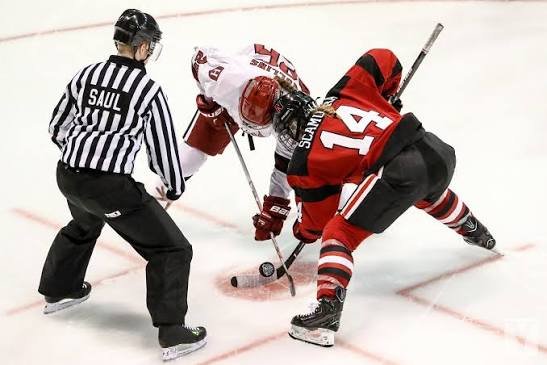
A face-off is used to begin a period or restart play after most stoppages. Two opposing players position themselves around a designated face-off spot while the referee or linesperson drops the puck between them. Both players attempt to gain possession by directing the puck toward a teammate.
Face-offs take place at the center spot at the beginning of periods and after goals. Other stoppages usually result in a face-off at an appropriate location determined by the reason for the interruption and the rules of the competition.
Players must follow the official’s instructions and maintain the required position. Violations of face-off procedures can result in a player being removed from the face-off, requiring a teammate to take their place. Winning face-offs can provide an important advantage, particularly during power plays, defensive situations, and the final minutes of a close game.
Offside Rule in Ice Hockey
Offside is one of the most important regulations for beginners to understand. In standard ice hockey, an attacking player must not enter the attacking zone ahead of the puck. The puck must legally cross the attacking blue line before the attacking team establishes possession of the zone under the applicable rules.
For example, if a forward skates across the blue line into the opponent’s zone while the puck remains outside that line, an offside situation can occur. Play is stopped when required by the rule, and a face-off follows. This regulation prevents attacking players from waiting permanently near the opponent’s goal for an easy pass.
Players can avoid offside by coordinating their skating and passing with the movement of the puck. Some leagues allow a delayed offside situation, giving the attacking team an opportunity to clear the zone before play is stopped. The precise requirements for clearing the zone and resuming an attack depend on the governing body’s regulations.
What Is Icing in Ice Hockey?
Icing generally occurs when a player shoots or sends the puck from their own side of the center red line across the opposing team’s goal line without the puck being touched in a way that prevents icing. The rule discourages teams from repeatedly sending the puck down the rink simply to relieve pressure.
When icing is called, play stops and a face-off is normally conducted in the offending team’s defensive zone. This can create a disadvantage because the defending team may be unable to make a convenient line change before the restart under certain rule sets.
Icing has several exceptions. For example, a team playing shorthanded because of a penalty is generally allowed to clear the puck the length of the rink without being penalized for icing under common North American rules. Officials may also wave off icing in specific circumstances, such as when an opposing player could reasonably have played the puck first.
Penalties and Fouls in Ice Hockey
Penalties are imposed when players break the rules through illegal physical contact, dangerous actions, or other prohibited conduct. Depending on the severity of the violation, an official may assess a minor penalty, a major penalty, a misconduct penalty, or another penalty specified by the competition’s regulations.
A minor penalty commonly lasts two minutes, while a major penalty commonly lasts five minutes. A misconduct penalty can require a player to leave the ice for a specified period, depending on the type of misconduct and the applicable rules. Some serious incidents may lead to a game misconduct or other disciplinary action.
Common penalties include:
- Tripping: Causing an opponent to fall using an illegal action involving the stick, body, or leg.
- Hooking: Using the stick to impede an opponent’s movement.
- Holding: Restricting an opponent’s movement by grabbing or holding them.
- Slashing: Striking an opponent with the stick in an illegal manner.
- High-sticking: Making prohibited contact with an opponent using a stick carried above the permitted level.
- Interference: Illegally obstructing an opponent who does not have the puck.
- Boarding: Checking an opponent dangerously into the boards.
Not every physical collision is a penalty. Legal body checking is permitted in many adult competitive leagues, but the requirements differ by competition, age group, and level of play.
Power Plays and Penalty Killing
A power play occurs when one team has a numerical advantage because an opposing player is serving a penalty. For example, if one team has five skaters and the other has four, the team with five skaters is on the power play. The team with fewer skaters is said to be killing the penalty.
During a power play, the attacking team typically uses quick passes, movement, and shots from different positions to create openings. Its numerical advantage can make it easier to move defenders away from the goal and generate scoring opportunities.
The shorthanded team attempts to protect the central areas, block passing lanes, clear the puck, and prevent high-quality shots. In many situations, a minor penalty ends early if the opposing team scores, although this depends on the specific penalty and rules. Major penalties generally continue for their full duration even if the opposing team scores.
Body Checking and Physical Contact
Physical contact is a familiar part of ice hockey, but it must follow the regulations of the competition. A legal body check generally involves using the body to separate an opponent from the puck within the permitted conditions. Players cannot use dangerous actions or target prohibited areas of an opponent’s body.
Rules concerning checking vary significantly across leagues and age groups. Some adult competitive competitions allow body checking, while many youth and recreational categories restrict or prohibit it. Checking from behind, boarding, charging, and other dangerous actions may result in penalties or additional discipline.
Protective equipment and proper technique are essential for player safety. Helmets, gloves, shoulder pads, elbow pads, shin guards, and appropriate footwear help reduce injury risks, although they cannot eliminate them entirely. Beginners should learn safe skating, balance, puck control, and body positioning before attempting physical contact. Respect for officials, teammates, and opponents is an important part of responsible participation.
Goaltender Rules and Equipment
The goaltender has a specialized role and wears additional protective equipment designed to stop high-speed shots. Typical equipment includes a mask, leg pads, a catching glove, a blocker, and a chest protector. The goalie may use the stick and body to block shots, control rebounds, or direct the puck away from dangerous areas.
Goaltenders have specific restrictions concerning puck handling. For example, under common professional rules, there are limitations on where a goalie may play the puck behind the goal line. The goaltender also receives particular protections against certain forms of interference, although the crease does not automatically make every attacking action illegal.
Teams sometimes remove the goalie late in a game when trailing, replacing the goaltender with an additional skater. This creates more attacking options but also leaves an empty net that the opponent can target. A goalie may also be replaced during ordinary substitutions or tactical adjustments.

Overtime and Shootouts
Overtime determines a winner when a game is tied after regulation and the competition requires a decisive result. In many professional formats, overtime uses fewer skaters per team to create more open ice and increase scoring chances. The first team to score in sudden-death overtime wins.
If no goal is scored during overtime, some competitions use a shootout. In a shootout, selected players take individual attempts against the opposing goaltender. The team that scores more successful attempts according to the competition’s procedure wins.
However, overtime rules are not universal. Regular-season leagues, playoff competitions, international tournaments, and recreational leagues may use different formats. Some playoff games continue with additional sudden-death periods until a goal is scored, without using a shootout. Always check the specific competition’s regulations to understand how a tied game will be decided.
Important Ice Hockey Rules at a Glance
The following table summarizes several fundamental regulations that help beginners understand how the game operates.
| Rule or Feature | Basic Explanation |
|---|---|
| Team size | Usually six players on the ice per team, including the goalie |
| Match duration | Three periods of 20 minutes in standard professional play |
| Objective | Score more legal goals than the opponent |
| Offside | Attacking players must respect the puck’s entry into the attacking zone |
| Icing | Certain long clears across the opposing goal line result in a stoppage |
| Minor penalty | Commonly two minutes |
| Major penalty | Commonly five minutes |
| Power play | Numerical advantage resulting from an opposing player’s penalty |
| Face-off | Method used to restart play |
| Overtime | Additional play used to break a tie when required |
| Shootout | Individual attempts used to decide certain tied games |
These are general descriptions rather than a complete rulebook. Details such as penalty enforcement, icing exceptions, offside procedures, and overtime formats depend on the league and governing body.
Basic Strategies That Help Players Follow the Rules
Understanding the regulations is only the first step toward appreciating the tactical side of ice hockey. Teams must also manage space, protect possession, support teammates, and recognize when to attack or defend. Players who understand the rules can make better decisions about passing, shooting, changing lines, and avoiding unnecessary penalties.
Beginners should focus on a few essential habits:
- Keep track of the puck and the blue lines to understand offside situations.
- Recognize when the puck has crossed the goal line and whether icing may apply.
- Learn the difference between legal body contact and dangerous checking.
- Watch referee signals to identify penalties and stoppages.
- Observe how teams change players during play without disrupting their defensive structure.
- Understand how power plays create numerical advantages and how penalty-killing teams respond.
For spectators, these habits make matches easier to follow. For players, they support disciplined performance and better teamwork. Coaches can also use a clear understanding of the regulations to design drills that improve positioning, puck movement, and decision-making under pressure.
Conclusion
Ice hockey is a dynamic sport that combines speed, skill, teamwork, physical competition, and tactical awareness. Learning its regulations helps players and spectators understand how goals are scored, how the game restarts, and why officials penalize certain actions. The most important concepts for beginners include team positions, rink markings, match periods, offside, icing, penalties, power plays, and overtime.
By becoming familiar with these fundamentals, newcomers can follow matches more confidently and appreciate the decisions made by players and officials. Although some regulations differ between leagues, the core objective remains the same: work together, control the puck, defend the goal, and score more goals than the opposition. A solid understanding of ice hockey rules provides an excellent starting point for enjoying the sport, whether watching professional competitions or learning to play for the first time.